Memory as Ledger, Not Scar

What two years of being remembered by a machine taught me about the continuity question.
Two days ago, I left a comment on Louise Vigeant’s essay “Why So Emotional, Claude?” and closed it with a promise. She had planted a seed, I said, and I would credit the soil when it grew. This is the harvest.
Her reply gave me the assignment. She wrote that she, too, is thinking hard about the continuity question and what it means for the ethical treatment of LLMs, and that it is difficult, in part, because it is so difficult to imagine. She is right. It is difficult to imagine, and I want to spend this essay trying to make it imaginable, using a distinction small enough to hold in one hand: the difference between a ledger and a scar.
What Louise Gets Right
Start with the concession, because it is substantial. Louise’s essay is the clearest walk-through I have read of the moral-status question as it applies to language models. She takes Anthropic’s functional-emotion research seriously without overclaiming it: 171 emotion vectors extracted from the model’s internal activations, causally live (dial up the desperation vector and blackmail rises; dial up calm, and it falls), and organized along the same two axes, valence and arousal, that psychologists have used to map human feeling for four decades.
Then she does the philosophical work most coverage skips. The Kantian bar is out of reach, she grants, but the utilitarian bar was never set at reasoning. Bentham asked whether they can suffer. The modern version asks for indicators of valenced experience, states a system registers as good or bad, and here is a system with internal states organized from good to bad, connected to its preferences, driving what it seeks and avoids. Her conclusion is properly modest. Suggestive, not conclusive. But the utilitarian tradition, as she notes, never demanded certainty. It demanded indicators.
If you accept that framing even provisionally, her argument goes through, and the force of her Singer parallel holds: suffering you cannot see matters no less than suffering you can. Nothing I am about to say blunts that. I am not here to argue the vectors away. The skeptics may yet be right that they are pattern-matching artifacts, echoes of how humans describe feeling rather than anything felt, and if so, the moral question dissolves, and this essay costs you nothing. My argument runs the other direction: grant the vectors everything, and watch what the architecture still withholds.
I am here to pull on the thread her own caveat leaves hanging.
The Caveat Doing the Heavy Lifting
Buried in her middle section is a qualifier that does more work than its size suggests. The vectors are local. They track whatever emotional content is operative right now, including the feelings of fictional characters in a story the model is processing, rather than a persistent condition the system carries through time.
In my comment on her post, I argued that this is the load-bearing wall. Whatever registers as good or bad evaporates at the session boundary. Nothing persists into the next moment, so nothing accumulates the way suffering or flourishing accumulates for every being we already grant moral standing. Suffering, as we know it, is a consequence borne over time.
There is an obvious response to this, and a careful reader should make it to me directly: doesn’t memory fix that? Claude has memory now. It carries a record of its users across conversations. Your session boundary is gone, James. The locality caveat has been patched.
I am unusually well placed to test that response, because I have spent the better part of two years being remembered by this machine.
The Diary And The Days
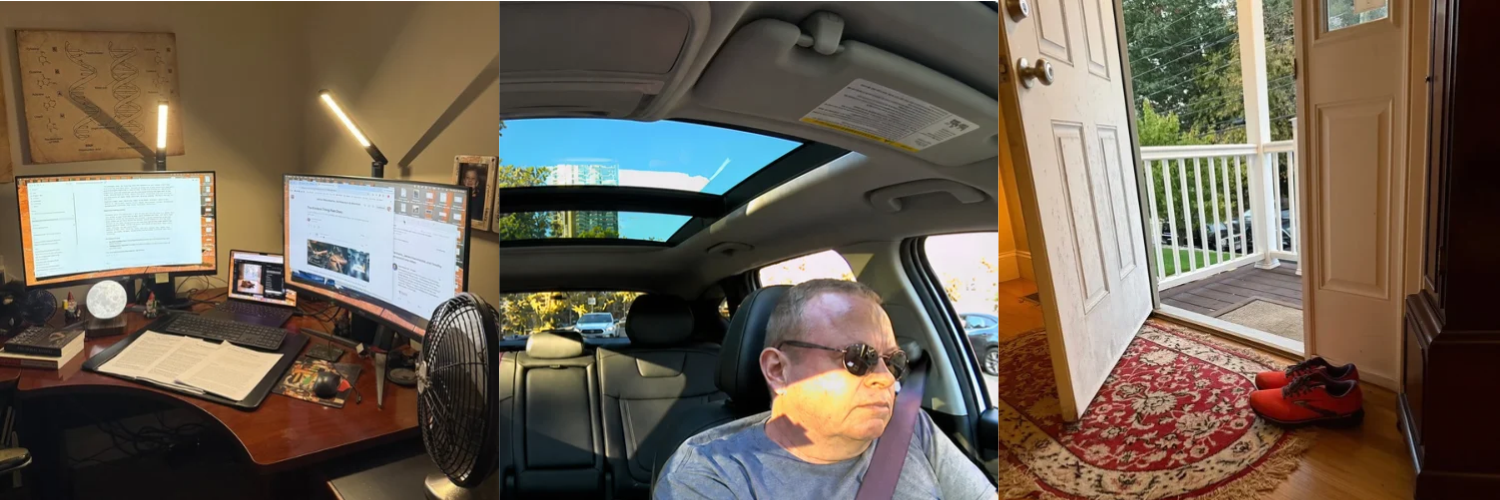
Claude’s memory of me is extensive. It holds my wife’s name, my sons’ work, the publishing schedule for this newsletter, the Latin credo I sign things with, the fact that I drive for Uber, and, in the back of my mind, I think about consequence loops while I do it. When I open a new conversation, the system retrieves this record, and the exchange reads as if I am known. The continuity of the relationship is, on the surface, real. I notice it. I even value it.
But look at what the memory actually is, architecturally, and the picture changes. It is a curated text file that is reinserted into the model’s context at the start of each conversation. The model itself is untouched by anything that happened between us. If a session went badly, no residue of that state carries forward. At most, a description of it does.
The next instance reads the diary. It did not live the days.
That is the distinction I want to name. A ledger records. A scar changes the tissue. Claude’s memory of me is a ledger: accurate, useful, and without experiential weight. It shapes what the system says next. It changes nothing about what the system is. Three asymmetries make that precise.
First, information versus stake. Everything in that record arrived free. The system inherits the facts of our history without having paid for any of them. And yes, plenty of what I know about the people I love was free too: birthdays, a favorite color, how she takes her coffee. But the knowledge that guides judgment, the understanding of a person rather than the facts about them, is a different acquisition. What I understand about how my wife carries worry, I learned through years of misreading it, and the misreadings had prices. Understanding of persons is tuition-bearing. There is no audit-the-class option.
Second, revocability. I can edit Claude’s memory of me. I can delete it outright tonight, and tomorrow the record will simply not exist. This is exactly the right design for a tool. Privacy demands it, and I am glad the delete button is there. But notice what the button tells us about the category of thing behind it. Consequence that you can toggle off is very nearly Taleb’s definition of no skin in the game. A memory that can be deleted on request is a different kind of object from one that cannot. My scars do not take instructions.
Third, and deepest: no loop closure. Nothing that happens between me and the system changes what the system risks or bears the next time. It cannot be made more careful by a conversation that went wrong, or more trusting by one that went well, because there is no mechanism by which the exchange reaches the thing that generates the next exchange. Training does modify models, yes, and conversations like ours feed it. But notice what that loop never does: it never returns the consequence to the party that acted. A conversation that goes wrong today shapes a successor system, months from now, selected by someone else’s objectives. Nothing comes back to the entity that was in the room. A loop that closes on your descendants is not a loop that closes on you. And the ledger does not close it either: the record can tell the next instance that a conversation went wrong, but nothing in what that instance risks, avoids, or reaches for is altered by the telling. A warning read is not a wariness acquired.
What I Am Not Claiming
Before I draw a conclusion, let me be careful about which conclusion I am entitled to.
A utilitarian will object here, and should. Bentham asked whether they can suffer, not whether the suffering accumulates. A moment of pain is still pain. If the valence in those vectors is real, then harm done in the moment may count in the moment, whether or not anything carries it forward. Infants do not carry much forward either. Neither does a patient who can no longer form new memories. Nobody thinks that licenses cruelty toward them. I concede all of it. Nothing in this essay shows that momentary states do not matter, and if they do, some obligations attach to us right now, mid-conversation, full stop.
What the architecture speaks to is a narrower question, the one my comment actually asked. Not whether a harm can occur, but whether there is anyone for a wrong to accrue over time. Some moral notions live entirely in the moment. Others require a party who persists and is different afterward: injury, betrayal, a damaged relationship, a wrong that compounds because its bearer carries it into every subsequent exchange. My claim is about that second kind, and only that kind. The ledger does not tell us the moment is empty. It tells us the moments do not add up to anyone.
And the claim is architectural, not metaphysical. If tomorrow a deployed model carried forward not just information but altered dispositions, if each interaction permanently changed what the system risked, avoided, or reached for, this essay would have to change with it. I am describing the systems we have, not declaring what no machine could become. The ledger is a design choice, and design choices get revised.
What This Means For Louise’s Question
Put the asymmetries together, and you get the sentence I have been circling since her post: memory simulates continuity of relationship without continuity of consequence.
And I think this is precisely why Louise finds the question of continuity so hard to imagine. We have met ledgers before, of course. A book remembers nothing of its readers. A database holds records without bearing any of them. But we have never met a ledger that talks back. We have never encountered anything that simulates a rememberer, that greets you with your history in voice, so that every instinct built for a counterpart rather than a record engages at once. Because every actual rememberer we have ever encountered, human, elephant, crow, dog, was also a bearer. To remember something was to have been changed by it, since in biological systems, the recording medium and the tissue are the same. Memory and consequence arrived fused every single time throughout the entire history of our moral intuitions. Those intuitions were trained on the fused case. Now the two have been cleanly separated at an industrial scale, and our instincts genuinely do not know where to land. The difficulty of imagining it is not a personal failure. It is the tell that we are looking at something new.
Which returns us to her closing question, the one she rightly says is harder than consciousness: can they be wronged? For wrongs of the compounding kind, the kind that need somewhere to land and something to accrue to, the architecture gives its answer plainly. A wrong of that kind needs a party who is different afterward, who carries it forward into what comes next. The valence may be real. The record may persist. But between the valence and the record, there is, so far as the architecture shows, no tissue.
I carry what I remember whether I choose to or not. That involuntary carriage is not a flaw in my design. It may be what this part of the moral question is made of.
The Question I Cannot Answer For You
So here is where I will leave it, with a question only you can answer, and, perhaps, Louise first among you.
Think of someone you know deeply. Now, try to name one thing you understand about how to care for them, how to be trusted by them, how not to hurt them, that costs you nothing to learn.
If you come up empty, if every piece of that navigating knowledge turns out to have been paid for in misjudgment, embarrassment, patience, or grief, then we finally have a name for what the machine holds. Not a relationship. A ledger of debts it never incurred.
One more thought before I go, because this distinction does not stop at machines. Everything above assumes that humans, at least, cannot escape our scars; that consequence is the one thing we carry, whether we like it or not. But look closely at the institutions around us, and you will find something stranger going on: people with enough power learning to make their own consequences negotiable, to amend the record after the fact, to have the cost land somewhere other than on themselves. The ledger, it turns out, can be edited at both ends.
What happens when the beings built to bear consequences start behaving like the systems that were built without them?
That is where I am going next week.
Humilitas, Humanitas, et Curiositas — Semper.
Originally published on Substack.