The Fasten Your Seatbelts Century - Again
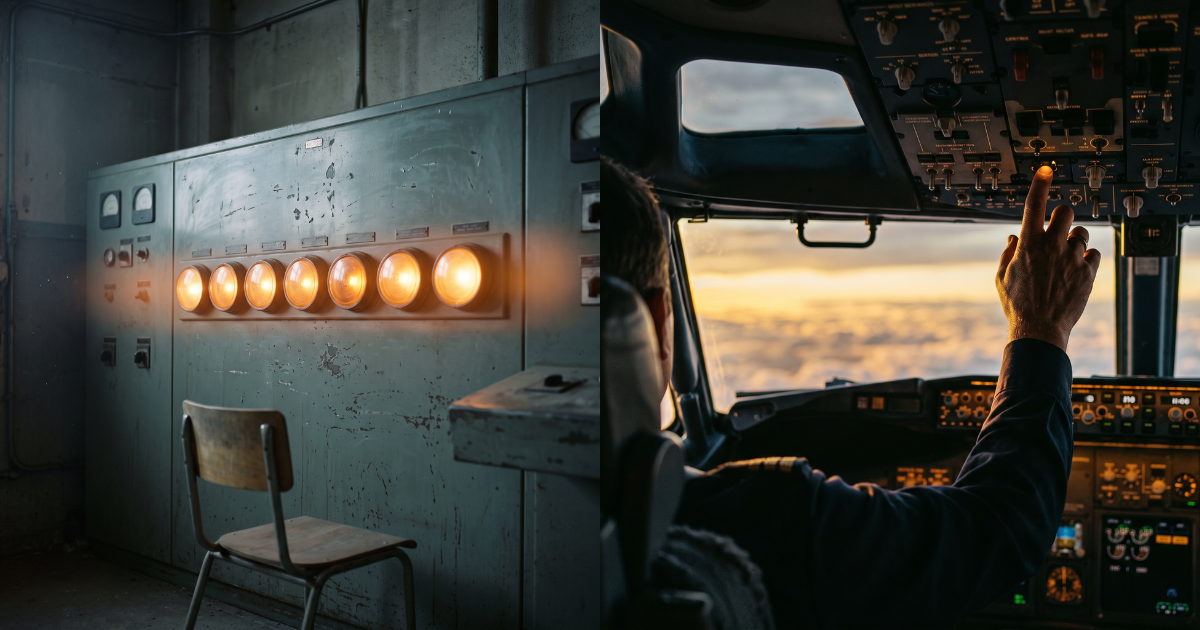
A warning that never turns off stops carrying information, even when it’s right.
I turned on my own seatbelt sign about four years ago.
I had been reading the same headlines as everyone else, and I reached a conclusion I found hard to argue with: too many things could go wrong at once, and most of them would hit the markets before they hit anywhere else. So I moved a good part of my retirement savings somewhere I judged safer. It wasn’t a trade. It was a posture. I buckled in and waited.
Nothing happened.
Four years on, the sign is still lit. Recently I made a list of the warnings that keep it lit, and introduced them with the phrase “only a couple of blinking warnings that I’m aware of.” Here is the list.
- Government debt that nobody has a plan to repay ($40T)
- A bond market that hasn’t settled
- Share prices that assume nothing goes wrong
- A technology boom that is partly financing itself (AI)
- Whatever that boom does to jobs
- A war with no sign of ending (Ukraine)
- A standoff that could become another (reader’s choice - US/Iran, China/Taiwan, North Korea/South Korea)
Then I counted. There were seven.
That gap between “a couple” and seven is what this essay is about. It isn’t evidence that things are worse than I thought. It might be evidence that I’ve stopped being able to read my own instruments.
Here is what I’ve done since. I’ve quietly moved some of that money back. Not all of it. Enough to notice.
I don’t know whether that was judgment or fatigue.
The Sign
On a plane, the seatbelt sign works because of three things you rarely think about.
The first is that someone with better information than you switches it on. The captain can see the weather radar and hear reports from aircraft further ahead. You can see a cloud.
The second is that the captain is on the plane. If the turbulence turns out worse than expected, the captain feels it too. That doesn’t make the captain infallible. It means the person switching the sign on pays when they get it wrong, which is why you can obey it without being told the reason.
The third is the one this essay depends on: the sign goes off. On a smooth flight it stays dark most of the time, so when the chime sounds, it means something. The sign carries information because it isn’t always on.
Take away the first two and the sign becomes harder to trust. Take away the third, and it becomes part of the cabin.
The Last Time the Sign Was On
First, what this essay isn’t claiming. The twentieth century was the bumpy one: two world wars, a depression, a pandemic that killed tens of millions, and four decades in which two governments could have ended most life on earth in an afternoon. If a century ever had its seatbelt sign on, that one did.
Many of us in the West who came of age around the end of the Cold War believed it had gone off. Since the autumn of 2001 it has been on for most of the time: two long wars, a financial crisis that came close to freezing the banking system, a pandemic that closed much of the world, inflation back after a generation away, war in Europe and the Middle East, and political turmoil in democracies long thought stable.
That is a selective list. The same years brought falling extreme poverty and longer lives, and I’m not claiming the world got worse. I’m describing how the sign has behaved. What stands out is how short the quiet stretches have been.
When the Alarm Never Stops
Hospitals have studied what happens when a warning never turns off, because there the cost is counted in patients.
A patient on a modern ward can be connected to several monitors at once, tracking heart rhythm, oxygen, and blood pressure, each set to sound when a number crosses a line. Each alarm makes sense on its own. Together they can produce several hundred alarm signals per patient per day. The Joint Commission, the body that accredits most American hospitals, reviewed the research and found that between 85 and 99 percent of those alarms required no action.
Nurses adapt, as anyone would. They learn which beeps usually mean a loose sensor or a patient who shifted in bed. They turn the volume down, widen the limits, and sometimes switch alarms off. The field calls this alarm fatigue.
In 2013, the Commission issued a formal warning to hospitals about it. Over about three and a half years, it had received reports of 98 alarm-related events, 80 of which ended in a patient’s death. It noted that reporting is voluntary and that these cases are only a small share of what actually happens.
What matters here is how the failure happens. It is tempting to call it carelessness. It isn’t. A nurse who stops reacting is usually responding sensibly to what the alarms have taught them. When nine alarms in ten mean nothing, treating the next one as probably nothing is a reasonable bet. The trouble is that habit places the bet, not judgment, and the tenth alarm sounds exactly like the other nine.
The alarm didn’t stop working. It stopped carrying information. The sound stayed the same, but its meaning drained away.
Maybe the Air Is Rough
There is a fair objection here. Hospital alarms can be scored: afterward, we know which ones needed a nurse. The warnings on my list can’t be scored that way. Some take decades to resolve, and some never will. By a warning I mean a claim that something bad has become more likely and that you should act differently because of it. This difference has a name. Risk is what can be measured; uncertainty is what can’t. Hospital alarms are risk. Most of my list is uncertainty. Economists argue over some of it with better tools than mine, but nobody can yet say which of my seven are right.
So maybe the air really is rough, and the sign is on because it should be.
The argument doesn’t depend on ruling that out. Even if the sign is right, a sign that is always on can’t tell you when things get worse. Pilots already deal with this. When turbulence is expected to be severe, the captain adds a second announcement, “flight attendants, please take your seats,” because the seatbelt sign alone no longer marks the difference. In steady rough air, the useful signal is the one that separates this bump from the others.
That second announcement is what I think we’re missing: a way to tell which of seven lit signs deserves more attention than the rest.
Unbuckled or White-Knuckled
Without that second signal, people tend to go one of two ways.
The first is to unbuckle. After enough warnings that go nowhere, you stop listening. Headlines about debt, war, or the next crisis become background, like the hum of the engines. This feels like calm, and sometimes it is. But it is the nurse’s bet: the next warning is probably nothing. Most of the time that’s a reasonable bet, and it fails precisely when it matters.
The second is to stay white-knuckled. You keep the belt tight and never relax, treating every warning as the real one. This feels like prudence. But vigilance that never stands down has its own costs. It is tiring, it crowds out other things, and it has its own blind spot. If you treat everything as an emergency, you can’t pick out the one that is.
The relaxed passenger and the white-knuckled one look like opposites, but the sign has stopped telling either of them anything. One ignores it; the other obeys it constantly. Neither is reading it.
Both are settings, not decisions. Each replaces the question “does this warning mean something?” with a standing answer: no for one, yes for the other. Judgment is the ability to give different answers to different warnings. A sign that never goes off makes that very hard to do.
What I Can’t Tell
So what does another twenty or thirty years of this produce? I’ve kept hoping things would settle down. It’s a hunch rather than a forecast, but I no longer expect the sign to go off in my lifetime.
I don’t think the answer is collapse. Societies have absorbed worse than anything on my list. The more likely result is quieter. Some institutions warn too often; others warn too little. After enough years of a sign that never goes off, a public finds it harder to tell those apart.
Which brings me back to the money.
The simplest explanation for what I did is that I made a bad call four years ago and am slowly correcting it. That may be all it is. When I moved some of the money back, I told myself it was recalibration: four years is a long time for a warning to go unconfirmed, and a sensible person updates. But that is also exactly what the nurse tells herself about the tenth alarm. From inside, recalibration and fatigue lead to the same action and bring the same relief. I can’t tell which one I’m doing.
What I do know is that I’m not a passenger watching someone else’s sign. If I was right four years ago and have now relaxed, I’ll pay for it. If I was wrong all along, I’ve already paid in the growth I didn’t get. Either way, the cost lands on me, which puts me on the plane. In July I wrote about the difference between a ledger and a scar. A ledger records what happened. A scar changes the one it happened to. Whatever this decision turns out to have cost, it won’t just be written down somewhere; I’ll carry it. I can’t tell yet whether the scar will come from relaxing too soon or holding on too long.
Who Sets the Threshold
The answer on offer for a public that can’t sort its warnings is to let something else do the sorting. News feeds already decide which stories reach you and how urgently, and hospitals are trying smarter alarms. Some of this will help.
But a system that sorts warnings is a system that sets thresholds. It decides what gets through, what gets flagged as urgent, and what stays quiet. Three questions matter about any threshold. Who sets it? Who pays when it’s wrong? And does it ever switch the sign off?
On the plane, the answers are simple. The captain sets it, the captain is in the turbulence too, and the sign goes dark when the air is smooth. Most of the warnings on my list have no captain at all, only other passengers with different readings of the same instruments. That is part of why the sorting is drifting to software. With the systems now doing more of our sorting, the answers are harder to find. People we never see set the threshold, often tuning it at least partly to keep us watching. The model applying it bears none of the consequence of what it waved through, or of the years someone spent braced for something it flagged that never came. It can keep a perfect ledger of both. It carries no scar. And a system rewarded for attention has little reason ever to switch the sign off.
Some of the people building these systems have warned publicly about their own industry and asked for regulation. They are on the plane, and their warning is worth more for it. But the rule still holds: a sign means something only if it can also go off. The question to ask of any warning, theirs included, is what would make them switch it off, and whether anyone would notice if they did.
The captain is on the plane. The model isn’t. And for twenty-five years now, the passengers have been left to read the sign themselves.
Four years in, mine is still lit, and some of the money has come back.
I don’t know whether that was judgment or fatigue.
Source: The Joint Commission, Sentinel Event Alert Issue 50, “Medical device alarm safety in hospitals,” April 8, 2013.
Tags: Architecture & Attention, AI, Epistemic Humility, Systems Thinking, Decision Making, Attention Economy
Originally published on Substack.