
Mastery of Life
What Actually Matters (And How to Find Out)
We optimize everything: productivity, fitness, finances, sleep. There’s an app for each, a metric for every goal. But when did you last systematically examine whether you’re even focused on the right things?
A Different Perspective
Most self-improvement frameworks assume you already know your priorities. Pick your domains, set your goals, track your progress. But here’s the uncomfortable truth: priorities shift, and we’re often the last to notice. What mattered deeply at 30 might be irrelevant at 50. The relationship you took for granted becomes the thing you’d sacrifice everything else for. The career ambition that drove you for decades quietly stops mattering, but you keep optimizing for it anyway, out of habit.
The value isn’t in tracking what you think matters. It’s in discovering what actually does. And, just as importantly, what doesn’t.
Quick and Simple
The practice is simple: daily reflection, constrained. Five minutes, ideally at the same time each day. You score a set of life components, not with journaling or elaborate prose, but with a simple scale. Did this area drag me down today, lift me up, stay neutral, or just wasn’t a factor at all (not applicable)?
The constraint is the point. You can’t hide behind words. Over weeks, patterns emerge that surprise you. The thing you thought was critical to your happiness? Turns out it barely moves the needle. The thing you’ve been neglecting? Strongly correlated with your best days.
This isn’t about optimizing your life into a spreadsheet. It’s about building a muscle: the capacity to notice, reflect, and adjust. Most of us sleepwalk through our days. This practice interrupts that.
The Life Mastery Tracker
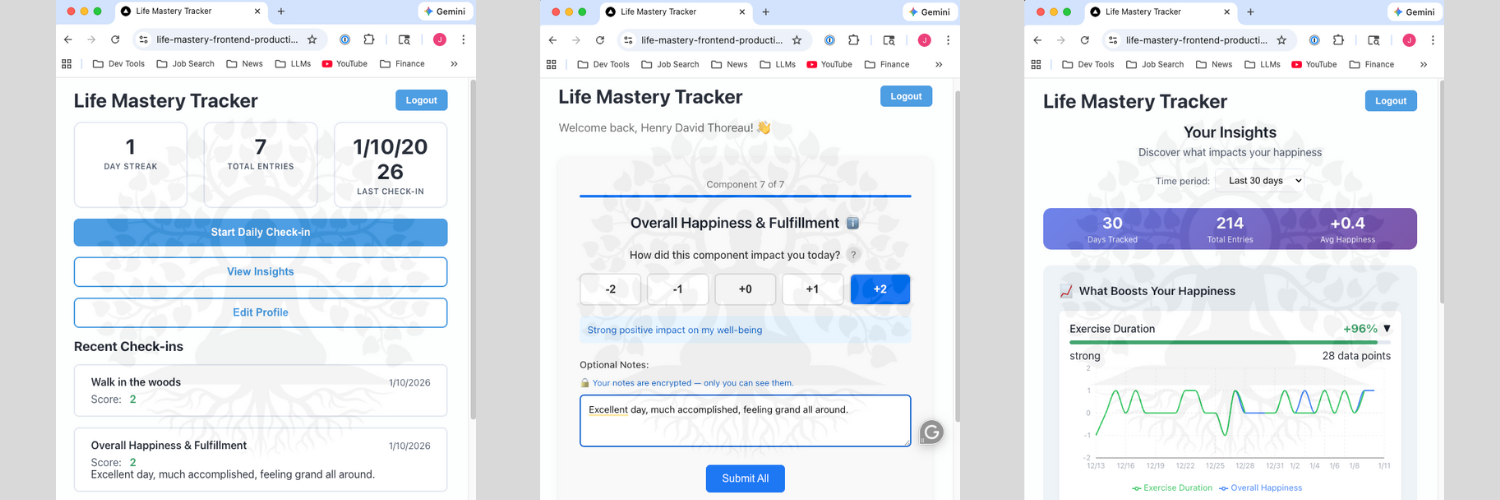
I decided to build a web app because it helped me think through what matters to me, gave me an opportunity to build one that I could use, and let me try several LLMs as coding assistants to learn their strengths and weaknesses for a non-coder.
The app is simple by design, and I am sure there is plenty of room for improvement in the user interface and functionality. I believe the latter will involve expanding the analytics based on experience and user feedback.
A few things worth noting:
It’s intentionally minimal. The check-in takes under five minutes. You score each component, your overall happiness and fulfillment, and include an optional note; you’re done. No gamification, no streaks-for-streaks-sake, no guilt. On the functionality front, I believe this will involve expanding analytics based on experience (e.g., developing a personalized utility function for happiness and fulfillment and aggregating anonymized, demographically segmented scores of standard components’ contributions to overall happiness and fulfillment).
You don’t need to get the components right up front. The profile setup process includes several ‘standard’ components that are important to me right now. You can select any that you think might be applicable to you, and you also have the opportunity to create your own custom components and scoring guidance. Custom components and scoring guidelines are encrypted and visible only to the user through the user interface. They will never be incorporated into any anonymized aggregated data.
Your data, your control. Custom components, scoring guidance, and daily notes are encrypted end-to-end; I can’t see them, and they’re never shared. Standard component scores (the ones you select from the preset list) can be anonymized and aggregated to surface patterns across users, for example, how “Sleep” correlates with overall happiness across different demographics. During the beta, this aggregation is required; afterward, you can opt out entirely.
Beta Testers Wanted
I’m looking for 50 beta testers.
The commitment: use the app daily for 30 days. At the end, share what worked, what didn’t, and what’s missing. I’ll incorporate feedback into the next iteration. Please note: for the purposes of the beta, users agree to the anonymized aggregation of their standard components, as described above. Beyond the beta, all users will be able to opt out of anonymized data sharing, including those who participate in the beta.
If that sounds like you: Life Mastery Tracker
No Application Required
Not ready to commit to an app? That’s fine. The practice can be done with a pen and paper, index cards, or a notes app. The web app is designed to reduce friction and, ultimately, to increase each user’s understanding of what matters to them and to gain insights from anonymized, aggregated data on the ‘standard’ components.
What matters is building the muscle. Everything else is scaffolding.
Try the practice manually:
- List 8–10 life components (e.g., Health, Relationships, Work, Learning, Creativity).
- Each day, score each on a five-point scale (from −2, indicating a strong negative impact, to +2, indicating a strong positive impact).
- After 2 weeks, look for patterns.
Looking Ahead: What Does This Have to Do with AI?
This kind of daily reflection, minimal, intentional, human-centered, is more than a personal practice. It’s a small-scale model for how we might design technology that augments rather than replaces human intelligence.
Next week, we’ll explore a related idea in artificial intelligence. Just as blindly optimizing for more data or bigger models won’t lead to true understanding, blindly optimizing our lives without reflection won’t lead to true fulfillment. The prevailing “bigger is better” narrative in AI is starting to crack, and what emerges next may look less like artificial general intelligence and more like augmented human intelligence, modular, attentive, and designed to elevate what humans do best.
If today’s tool helps you notice what truly matters in your life, next week’s piece will ask: What if we built AI to help us do exactly that?
This is part of an ongoing series exploring Augmented Human Intelligence and the architectural principles that might guide us toward AI systems that enhance rather than replace human judgment. If you found this interesting, consider subscribing to future posts on evolutionary processing units, attention architectures, and the intersection of human and artificial intelligence.